
Why Choose HSR for Sim Racing Wind Simulators
HSIMRACING builds wind simulators for sim racers who want more than improvised cooling. Since 2018, every range has been developed from a racing driver perspective, with a clear goal: deliver useful airflow, clean integration, and a product range that fits real setups from entry-level rigs to professional installations.
This page compares our systems with DIY builds and generic alternatives, using only what we actually build and publish today.
1. A Complete Range, From Entry-Level to Elite
HSR does not rely on a single flagship product. The range covers four distinct levels, so sim racers can choose a system that matches their budget, mounting constraints, and goals.
- Club Series — Eco, Spot, and Eco Duo. A plug-and-play starting point for adding real airflow to a rig.
- Sport Series — Sport and Sport Duo. A more refined finish with aluminium outlets and linear manual control.
- Pro Series — Pro, Pro Smart, and Pro Boost. 260+ CFM, USB-controlled digital motor, and native SimHub compatibility.
- Elite Series — Elite Solo and Elite. The range that introduces Velocity Stack and Quick-Mount technologies.
This depth matters. It means HSR can answer different use cases without forcing every customer into the same product philosophy.
2. Elite-Exclusive Technologies, Not Just Cosmetic Differences
Our strongest technical differentiation sits in the Elite range, which introduces two technologies exclusive to these products.
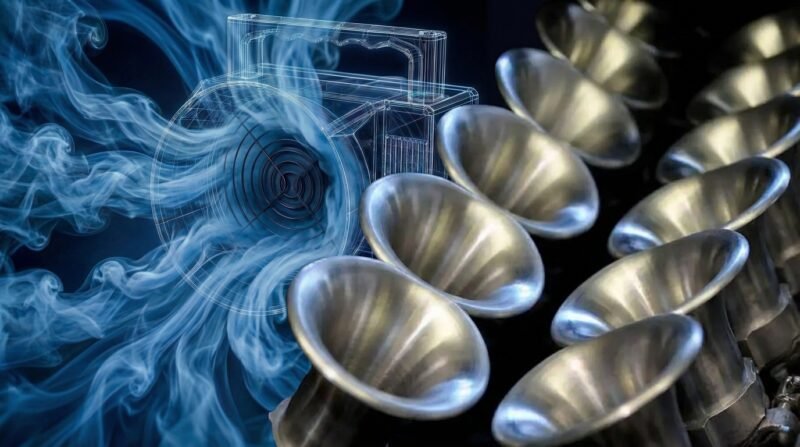
Velocity Stack
On the Elite range we use a proprietary intake geometry that accelerates the air mass before it reaches the blades. The result is +20% static pressure and -20% perceived noise. It remains exclusive to the Elite range.
Quick-Mount System
The Quick-Mount system is also exclusive to the Elite range. Its purpose is simple: faster rig reconfiguration without a fixed bolted setup.

Motorsport Components Where They Matter
Immersion is not only what you feel while driving, it is also what your rig becomes. That is why the outlets on the Pro and Elite ranges are real GT car air vents, and why the UltraSport option uses the aluminium outlets found in prepared cars, rather than moulded plastic made to look the part. Years of iteration went into that balance between airflow, comfort and hardware that genuinely belongs in a car. The tubes and outlets also change how a rig reads at a glance: more complete, more mechanical, closer to a real cockpit than to a desk with a fan beside it. On the Elite, the Velocity Stack intake is visible enough that more than one owner has joked it looks like it was designed by NASA.
3. Trust Signals Grounded in Real Installations
Our clearest proof point is the ULTRAWIND PRO, the model installed on Sébastien Loeb's simulator through a partner installation.
Our systems are also installed and trusted by recognized sim racing brands including Oplite, Sim-Lab, and Imsim. Those partner references matter because they show the products are not positioned only for isolated direct-to-consumer sales, but also for professional and partner environments.
More background is available on the Partners page.
4. Built in France Since 2018

HSIMRACING presents a simple but important positioning point: the company has been operating since 2018, and products are engineered and manufactured in Sarrebourg, France.
Our founder Julien Raidelet is a racing driver, and the brand is a workshop built from track experience rather than a marketing-first catalogue. That context matters when comparing HSR with generic alternatives, because the product logic stays consistent across the whole range.
You can read more about that approach on the About page.
5. Native SimHub Integration as a Key Product Advantage
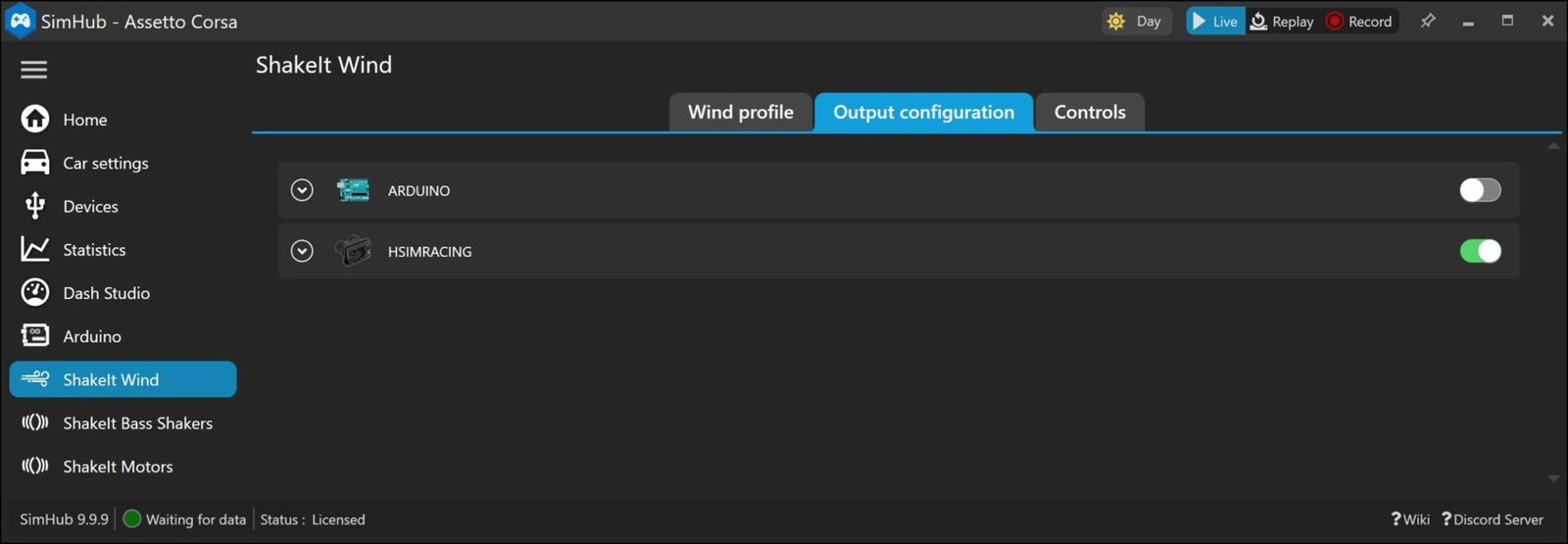
Native SimHub integration is something we build for deliberately. The principle is straightforward: plug in the USB-C cable, open SimHub, and the system is ready without drivers or proprietary software.
Our systems are compatible with 70+ supported games, including Assetto Corsa, iRacing, rFactor 2, F1, and Gran Turismo. For sim racers comparing solutions, that reduces setup friction and makes the product easier to integrate into an existing telemetry-driven rig.
6. How the Airflow Actually Reaches You
Most wind simulators point the fan turbines directly at the driver, mounted on a plate near the wheel base. UltraWind separates the two functions: the fan unit is installed wherever there is room on the rig, and the air travels through tubes to outlets mounted on flexible gooseneck arms.
- You choose the height of the airflow: face, chest, or feet.
- You can redirect the outlets by hand while driving.
- In VR, the air reaches your face instead of hitting the headset.
This is the central architectural difference with systems that aim a fan straight at the driver from a fixed position.
7. Mounting Does Not Require an Aluminium Profile
The system mounts on aluminium profiles of any size, but it is not limited to them. It also mounts on tubes, on wood, and on welded structures, using brackets, screw adapters, and long clamping collars.
The community gallery shows dozens of different configurations across very different rig types.
8. Multiple Units on the Same PC
Each fan unit carries a unique serial number derived from its microcontroller. Several units connected to the same PC therefore remain individually addressable in SimHub.
A concrete configuration: four outlets, with one unit on the left and one on the right driven independently, plus a third unit directed at the feet to get closer to the sensation of an open-cockpit single-seater.
9. How Loud Is It? An Honest Answer
Moving air produces noise. This is true of every wind simulator, whatever the brand: it is physics, not a design flaw. What can be engineered is the airflow-to-noise ratio, not the absence of noise.
This is where the Elite range is engineered furthest: its Velocity Stack intake is designed to deliver more static pressure while lowering the noise it generates, rather than simply running slower.
Measured noise levels are published on the product pages, so the choice can be made on numbers rather than on a claim.
10. Shipped to 45+ Countries
HSIMRACING has delivered orders to customers in more than 45 countries, from home rigs to professional installations. The wind simulator line itself has been in continuous production since 2018.
The core architecture has stayed the same across that period, which is why tubes and outlets remain compatible across generations.
11. Why Native SimHub Support Protects the Buyer
Hardware driven by a manufacturer's own application depends on that manufacturer staying in business and choosing to keep the software updated. If either stops, the hardware can become unusable even though nothing is physically broken.
A real case: a customer owns a motion seat whose manufacturer stopped updating its software. HSR wrote a plugin that makes the old application believe it is still driving the system, while SimHub actually runs behind it. This kept the seat usable for every owner of that model.
12. RGB Outlets: Race Information in Your Field of View
The air outlets can light up, driven independently on the left and the right by SimHub: blue and yellow flags, pit limiter blinking, and a proximity radar that flashes red on the side where a car is arriving.
Hand-built in very small batches, so availability is limited.
13. What Happens After the Sale
- The founder answers every message personally. A reply may well arrive in the evening or over a weekend. That is not a guaranteed service level, it simply happens because the person answering is genuinely passionate about the subject.
- Custom SimHub profiles are written on request.
- When a cheaper model is the better fit, it is recommended, even when it means a smaller sale.
14. HSR vs DIY and Generic Alternatives
| Feature | HSR Wind Simulators | PC Fans / DIY | Generic Alternatives |
|---|---|---|---|
| Range depth | Four tiers: Club, Sport, Pro, Elite | Depends on what you build yourself | Varies by brand, often narrower |
| SimHub integration | Native integration highlighted on HSR wind simulator pages | Usually requires a custom approach | Varies by product |
| Exclusive technologies | Velocity Stack and Quick-Mount on Elite | No HSR-exclusive technologies | Varies by product |
| Public trust signals | Sébastien Loeb partner installation, Oplite, Sim-Lab, Imsim | No brand-level trust signal | Varies by brand |
| Manufacturing story | Presented as engineered and manufactured in France since 2018 | Self-built | Varies by brand |
| Upgrade path | From entry-level rigs to premium configurations | Depends on each build | Varies by catalogue |
| Airflow architecture | Fan unit placed anywhere, air routed through tubes to gooseneck outlets | Fan usually pointed directly at the driver | Usually a fan aimed at the driver from a fixed plate |
| Mounting compatibility | Aluminium profile of any size, tube, wood, welded structure | Depends on the build | Often tied to a specific mounting plate |
| Multi-unit addressing | Unique serial per unit, independently addressable in SimHub | Not available | Varies by product |
| Software dependency | Native SimHub, no proprietary application required | Custom code to maintain yourself | Often a manufacturer application |
This is the most practical difference: HSR is not just selling a fan effect. It offers a full range, a clear upgrade path, and identifiable technologies tied to specific products.
15. Common Questions Before Choosing
The product and the technical side
Do I need a specific rig or an aluminium profile to install it?
No. The system mounts on aluminium profiles of the 20, 30, 40 and 45 series, with 8 mm slots as well as 10 mm slots. We supply M8 screws and T-nuts, and our parts are drilled for M8 socket head screws. Our own reference is the 40 x 40 profile with a 10 mm slot, the one used by frames built for sim racing. And if your cockpit is not made of aluminium profile at all, you are still covered: brackets, screw adapters and long clamping collars let you fix it to tubing, wood or a welded structure. The community gallery shows dozens of different rig types.
Does it work with iRacing, Assetto Corsa or Le Mans Ultimate?
Yes. Airflow is driven by SimHub telemetry, which supports more than 70 titles including iRacing, Assetto Corsa, rFactor 2, F1 and Gran Turismo. No specific integration per game is required on your side.
Is a wind simulator loud, and which model suits a quiet room?
Yes, moving air makes noise, on every system and every brand. What differs is the airflow-to-noise ratio. Measured noise levels are published on each product page, so you can compare before deciding rather than rely on a claim. For a quiet room or closed headphones, choose a more measured model rather than the maximum output of the range.
Does it work with VR?
Yes, and the architecture helps here. Because the outlets sit on flexible gooseneck arms rather than being aimed from a fixed plate, the air can be directed at your face instead of hitting the headset.
Is HSR only for high-end rigs?
No. Our catalogue spans from Club Series entry products to Elite systems, and that depth is one of our strongest differences.
Which HSR model is installed on Sébastien Loeb's simulator?
The ULTRAWIND PRO is the partner-installed setup used on Sébastien Loeb's simulator.
What makes the Elite range different?
The Elite range is where we introduce our Velocity Stack and Quick-Mount technologies.
Where is the fan unit placed on the rig?
Wherever there is room: behind the seat, under the rig, or to the side. The unit does not need to face you, because the air is routed through tubes to the outlets, which are the only parts that need to be positioned in front of you.
Can I use two units for left and right?
Yes. Each unit has a unique serial number derived from its microcontroller, so multiple units on the same PC stay individually addressable in SimHub and can be driven independently.
Do HSR wind simulators require proprietary software?
No. Native SimHub integration, no drivers, no proprietary software.
What happens if you stop supporting the product?
UltraWind systems are driven by SimHub directly, not by a proprietary HSR application, so they do not depend on one company keeping its own software alive. HSR has even written a plugin to rescue a motion seat abandoned by its own manufacturer.
How can I improve my racing simulator?
Every upgrade that adds immersion tends to take something away in comfort: VR puts a warm headset on your face for a whole session, a direct drive base above 10 Nm asks real physical effort from your arms, and a motion rig shakes you around for an entire stint. Airflow is the exception, and that is what makes it worth knowing about, because it is the only upgrade that adds immersion and comfort at the same time, which is also why it works so well alongside all the others. For the rest, rigs tend to improve in a predictable order. A direct drive wheelbase changes how much the car communicates through the wheel. A load cell brake pedal makes lap times repeatable, because braking becomes a matter of pressure rather than travel. Triple screens or VR widen what you can actually see of the track. Motion and haptics usually come last, because they cost the most for what they add. Airflow is the one almost nobody thinks of first and the least expensive of the list: speed becomes something you feel instead of something you read, a long stint stops being uncomfortably warm, and the low rumble of the motor with the slight vibration it sends through the cockpit make the rig feel alive rather than static. And immersion is not only what you feel while driving: part of it is what the rig becomes. A real bucket seat, a genuine wheel rim or actual GT car air outlets change how complete and how serious the whole thing looks, in a way a generic accessory never does.
Ordering, delivery and support
When is my order shipped?
We ship within 2 working days. In practice it is often the same day or the next, but we prefer to announce a lead time we always meet rather than a promise we cannot always keep. You receive an email as soon as the parcel is handed to the carrier, with its tracking number.
How long does delivery take?
Around 2 days in France and 5 days in Europe once the parcel has left, with the rest of the world varying by destination. These times come on top of the dispatch time, so around 3 to 4 days in total in France.
Do I have to pay customs fees when ordering from the United States?
No. For deliveries to the United States, customs duties and import charges are prepaid by HSIMRACING and already included in the shipping cost displayed at checkout. Nothing further is due when the parcel arrives. Within the European Union there are no customs fees at all. Other destinations may be subject to local import charges.
How do I track my parcel?
The tracking number is emailed to you automatically the moment the carrier takes charge of the parcel, together with a tracking link. It also stays visible at any time in your account, under orders. The first scan can take up to twenty-four hours to appear, which is normal.
Is my unit tested individually?
Every fan we build is tested before it leaves the workshop, without exception. The Pro and Elite ranges go further: they ship with a signed, named quality record carrying their build number and the full list of checks performed, from bearing inspection to the extended full-power test. This is not batch testing. It is your unit that was tested.
Which payment methods do you accept?
Visa, Mastercard, Maestro, Cartes Bancaires, V Pay, American Express, PayPal, Apple Pay and Google Pay. No banking data passes through our site. The logos are shown again on the home page and when you validate your basket.
Can I return my order?
Yes, under the European right of withdrawal. The detailed conditions are on our Returns and Refunds page. One point worth knowing: on an order to the United States, the prepaid customs duties are not refundable, because they have already been paid to the administration.
What if my parcel arrives damaged or goes missing?
Tell us at contact@hsimracing.com as soon as you can, with photos of the parcel and of its contents. If the packaging is visibly damaged on delivery, refuse it or write reserves on the carrier's slip, which makes the case far simpler. All our shipments are insured and we handle the claim with the carrier ourselves, so you do not have to. You are re-shipped or refunded without waiting for the outcome of that claim. It has never happened so far, but the procedure exists.
What does "made to order" mean on a product page?
It is rare, and it only concerns a model that is temporarily unavailable. It is then assembled for you, and the page announces a lead time of about one month, matching the next build slot. If you want a more precise date before ordering, write to us through the contact form or on WhatsApp. Otherwise we tell you as soon as the order is placed.
Ready to Choose the Right HSR Range?
If you want the simplest starting point, begin with the Club range. If you want the partner-installed reference model, look at the Pro range. If you want HSR's most advanced technologies, explore the Elite range.